Clinical Rehabilitation

Wheelchair Seating, Positioning, and Mobility Prescription: From Mat Table to Delivery

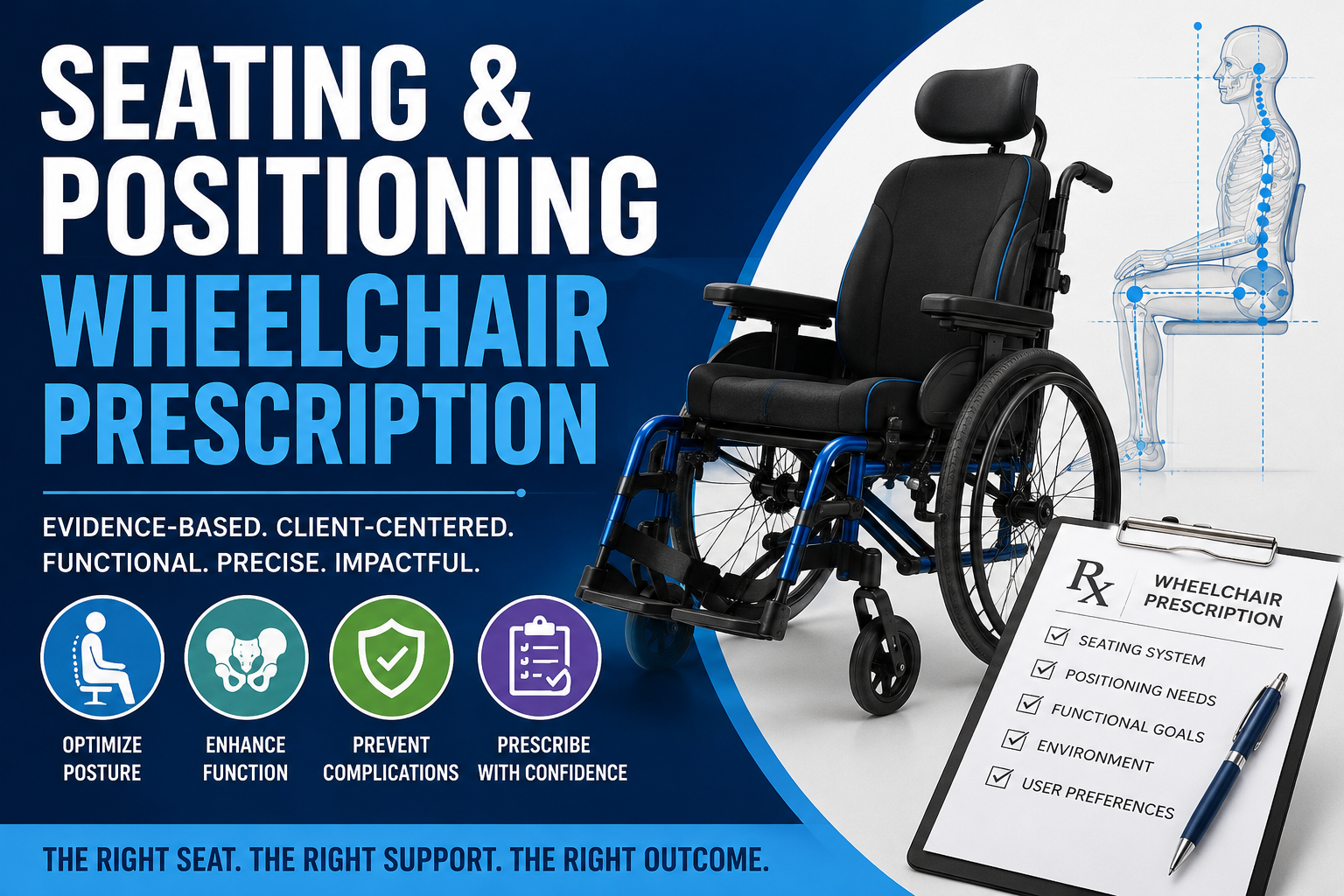
A deep-dive continuing education course for physical and occupational therapists who evaluate, prescribe, and fit wheelchair seating and mobility systems. You will move through the full service-delivery pathway: the biomechanics of seated posture, the mat assessment, pressure management, manual and power wheelchair prescription, funding and documentation, and delivery, fitting, and training. A dedicated module covers Mobius Mobility and the iBOT Personal Mobility Device, including its six operating modes, clinical candidacy, and funding pathways.
Dr. Russ L'HommeDieu, DPT
8 Modules
10 Sections
0 Contact Hours

Multi-Modal Learning Experience

Read

In-depth content with text-to-speech

Watch

Curated video content from experts

Listen

Podcast episodes and audio resources

Apply & Reflect

AI-coached practice and reflection

Course Outline

1
Module 1: Foundations of Seated Posture and the Goals of Seating
After this module you should understand that seated posture is governed by the position of the pelvis in three planes, and that every seating intervention exists to serve one or more of five goals: postural support, pressure management, function, comfort, and physiological health.
1 section

The Pelvis in Three Planes and the Five Goals of Seating

Module Quiz Required to Progress
2
Module 2: The Wheelchair Evaluation and the Mat Assessment
After this module you should be able to conduct a complete wheelchair evaluation — interview, supine and seated mat assessment, and body measurements — and use it to determine which postures are reducible, where external support is required, and what dimensions the seating system must have.
2 sections

The Interview and the Supine Mat Examination

The Seated Assessment, Hand Simulation, and Body Measurements

Module Quiz Required to Progress
3
Module 3: Pressure Management, Skin Integrity, and Cushion Selection
After this module you should understand how pressure, shear, microclimate, and time interact to injure seated tissue, and be able to match cushion construction (immersion and envelopment versus contoured off-loading; foam, fluid, air, and hybrid media) and pressure-relief behavior to an individual's risk profile.
1 section

How Sitting Injures Tissue, and How Cushions and Behavior Protect It

Module Quiz Required to Progress
4
Module 4: Manual Wheelchair Prescription and Configuration
After this module you should be able to match a person to the appropriate manual wheelchair category, and configure the chair — especially rear axle position, seat slope, and overall weight — to protect the upper limbs and maximize propulsion efficiency and independence.
1 section

Chair Categories, Frame Choices, and the Physics of the Rear Axle

Module Quiz Required to Progress
5
Module 5: Power Mobility — Bases, Drive Wheel Configurations, and Power Seat Functions
After this module you should be able to differentiate power wheelchair groups and drive wheel configurations, match drive controls to a person's motor abilities, and justify tilt, recline, elevating legrests, seat elevation, and standing by their distinct physiological and functional purposes.
1 section

Bases, Drive Wheels, Drive Controls, and What Each Power Seat Function Is For

Module Quiz Required to Progress
6
Module 6: Funding, Medical Necessity, and the Letter of Medical Necessity
After this module you should be able to walk a case through the Medicare mobility algorithm — from mobility limitation through cane, walker, manual chair, scooter, and power wheelchair — and write a letter of medical necessity whose structure mirrors the payer's published coverage criteria.
1 section

The Medicare Mobility Algorithm and the Elimination Sequence

Module Quiz Required to Progress
7
Module 7: Mobius Mobility and the iBOT Personal Mobility Device
After this module you should know the iBOT Personal Mobility Device's lineage and manufacturer, be able to describe each of its six operating modes and the self-balancing technology behind them, identify who is and is not a clinical candidate, and explain the evaluation and funding pathways through which a person obtains one.
2 sections

From DEKA to Mobius: The Company, the Technology, and the Six Modes

Clinical Candidacy, the Evaluation Pathway, and Funding the iBOT

Module Quiz Required to Progress
8
Module 8: Delivery, Fitting, Skills Training, Outcomes, and Follow-Up
After this module you should be able to conduct a structured delivery and fitting visit, build a wheelchair skills training progression appropriate to the device and user, select outcome measures that capture whether the intervention worked, and design a follow-up and maintenance schedule that keeps the system working for years.
1 section

The Fitting Visit, Skills Training, Outcome Measurement, and the Long Follow-Up

Module Quiz Required to Progress

Ready to Begin?

Create an account or sign in to enroll and start your learning journey.